
Remains of 5,000-year-old noblewoman discovered in Peru: Stunning discovery

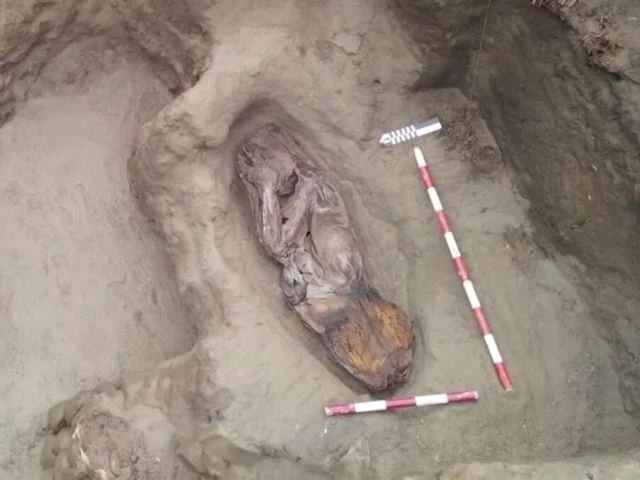
Archaeologists working in Peru have discovered the 5,000-year-old remains of a noblewoman from the ancient Caral civilization, which furthers our understanding of the role of women in one of the Americas’ oldest cultures.
The archaeological discovery site was located in the Aspero region. This region serves as an archaeological site in the city of Caral, located approximately 180 kilometres from Lima.
The remains are said to be exceptionally well-preserved and date back to approximately 3000 BC. Traces of skin, hair, and nails were discovered with them.
She was also wrapped in a shroud of fabric adorned with a mantle of prestigious macaw feathers signifying her upper-class birth.
Further emphasising her elite status, her tomb also contained a toucan’s beak, a stone bowl, and a straw basket.
The find was described as unusual by archaeologist David Palomino. He added that women during that period occupied high-ranking positions in Caral, which contradicts the understanding that women were not in leadership roles.
The Caral civilisation is believed to be one of the oldest in South America. While it thrived in an area with immense vegetation, it emerged around the same time as the civilisations of Egypt and Mesopotamia.
Valuable insights into the ancient civilizations of the Americas are provided through Caral, a site assessed as a UNESCO World Heritage Site in 2009.
Although exercise has numerous physical health benefits, many do not view it as a necessity. Without the right motivation, an individual may see exercise as too laborious and time-consuming, leading to avoidance of any effort associated with exercise.
Motivation, or the lack thereof, alongside positive and negative reinforcements, can be a powerful motivator. In some cases, one may feel too lazy. Due to the nature of a sedentary lifestyle, a person may tend to feel lacking in energy, leading to avoidance of physical endeavours.
