
Explosive Origins Igniting the Palestine-Israel Conflict: Facts, Wars & Unyielding Realities

1. Ottoman Collapse and the Balfour Promise
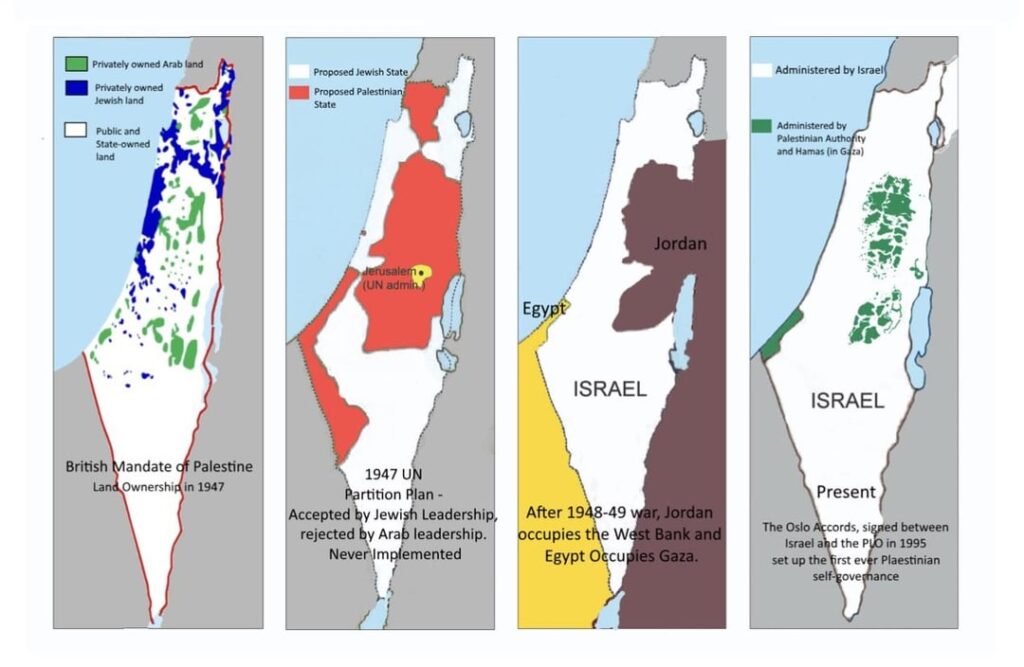
During World War I, Britain sought Arab support against the Ottomans and simultaneously reassured Zionist leaders of a “national home for the Jewish people” in Palestine via the 1917 Balfour Declaration. After the war, the League of Nations entrusted Britain with the Palestine Mandate, embedding the Declaration’s commitments into international law. This dual pledge—to Arab independence and Jewish statehood—planted the seeds of a zero-sum contest over the same territory.
2. Partition, Nakba, and the First Arab–Israeli War (1947–48)
In November 1947, the UN adopted Resolution 181 to partition Mandatory Palestine into Jewish and Arab states, with Jerusalem under international control. Jewish leaders accepted the plan; Arab states and Palestinian Arabs rejected it. When Israel declared independence on May 14, 1948, five Arab armies invaded. The ensuing war ended in early 1949 with armistice lines leaving Israel with 78% of the former mandate, and over 700,000 Palestinians displaced in what they call the Nakba (“catastrophe”).
3. Intifadas and the Fading Peace Horizon
Decades of occupation in the West Bank and Gaza culminated in two popular uprisings. The First Intifada (1987–1993) saw mass civil disobedience and the birth of Hamas amid stone-throwing protests. This spurred the 1993 Oslo Accords—signed clandestinely in Norway—which created the Palestinian Authority and envisioned a two-state solution within five years. Yet successive breakdowns, violence, and mutual recriminations derailed Oslo’s promise.
4. Gaza’s Repeated Wars (2008–2021)
Since 2008, Israel and Hamas have fought four major Gaza wars (2008–09, 2012, 2014, and May 2021). Each conflict began with rocket barrages from Gaza and ended with Israeli airstrikes and ground incursions that inflicted heavy civilian casualties and widespread destruction. Between these operations, Egypt-brokered ceasefires—often mediated by Qatar and the UN—have repeatedly collapsed, reflecting the deep mistrust on both sides.
5. The 2025 Gaza Onslaught and Humanitarian Ruin
In April 2025, over 60 Palestinians—including women and children—were killed in renewed Israeli airstrikes after ceasefire talks collapsed, pushing total Gaza casualties past 1,900 since hostilities resumed in March. Meanwhile, unexploded ordnance from thousands of strikes has rendered vast areas uninhabitable, hampering aid and reconstruction efforts amid a full Israeli blockade of the territory’s 2 million residents.
6. Military Dynamics: Rockets, Iron Dome, and Casualties
Hamas’ arsenal now includes precision-built rockets reaching major Israeli cities, while Israel relies on the Iron Dome missile-defense system to intercept incoming fire. Since March 2025, Israel reported over 400 military fatalities in Gaza operations; Palestinian health authorities estimate nearly 50,000 deaths and 116,000 injuries in the enclave since October 2023. Urban warfare, tunnel networks, and drone strikes further characterize this asymmetric confrontation.
7. Why Resolution Remains Elusive
• Irreconcilable Narratives: Palestinians see occupation; Israelis stress security and historical claims.
• Jerusalem’s Status: Holy sites in East Jerusalem are claimed by both, making compromise politically toxic.
• Refugee Question: Millions of Palestinian descendants demand a “right of return” that Israel rejects as existentially threatening.
• External Meddling: Regional rivalries (Iran vs. Gulf states) and great-power competition stymie unified mediation.
• Domestic Politics: Hardliners on both sides exploit the conflict for electoral gains, sidelining moderates and any genuine peace initiative.
8. Amplifying the Palestinian Narrative: Voices from the Ground
- Daily Reality under Occupation
More than 2 million Palestinians in the West Bank and Gaza live under varying degrees of military control. In Area C of the West Bank—comprising over 60 % of the land—Israel retains full security and administrative authority, restricting Palestinian building permits and uprooting olive groves. Checkpoints and the separation barrier fragment communities, turning what should be 20-minute drives into multi-hour ordeals. - Human Rights and Economic Strangulation
UN agencies report that over 50 % of Palestinian households in Gaza live in food insecurity, while unemployment hovers around 45 %. Water shortages—despite living on the coastal aquifer—are acute, as 95 % of groundwater is deemed unfit to drink. Collective punishment measures such as blockades and import bans for building materials deepen this humanitarian crisis, fueling despair and radicalization. - The Refugee Legacy
Roughly 5 million registered Palestinian refugees (and their descendants) live in camps across Jordan, Lebanon, Syria, the West Bank, and Gaza. Many remain housed in flimsy UNRWA shelters, with generations born into statelessness. Their right of return—enshrined in UN Resolution 194—is more than symbolism: it represents the restoration of homeland and dignity. - Grassroots Resistance and Civil Society
Beyond armed groups, a vibrant non-violent movement persists: weekly “Friday protests” in villages like Nabi Saleh challenge land seizures; youth-led “sumoud” (steadfastness) initiatives organize eco-tours into Area C to assert Palestinian presence; and women’s cooperatives in Gaza produce handicrafts and olive oil, channeling profits back into displaced communities. - Cultural Resilience
Under siege, Palestinians have sustained a rich tapestry of poetry, music and film. Gaza’s underground film festivals screen documentaries on blockade life; West Bank rappers like Shadia Mansour use art to critique checkpoints; and annual olive-harvest festivals celebrate the very trees bulldozed by settlers. - Calls for Justice and a Future Beyond Occupation
Palestinian legal advocates are pressing cases before the International Criminal Court over alleged war crimes; diaspora activists in Europe and North America lobby for import bans on goods from settlement farms; and young leaders—whether engineers in Ramallah or doctors in Shifa Hospital—articulate a two-state vision grounded in mutual security and equal rights.
