
Netanyahu Warns of More Strikes on Hamas Leaders Abroad 2025

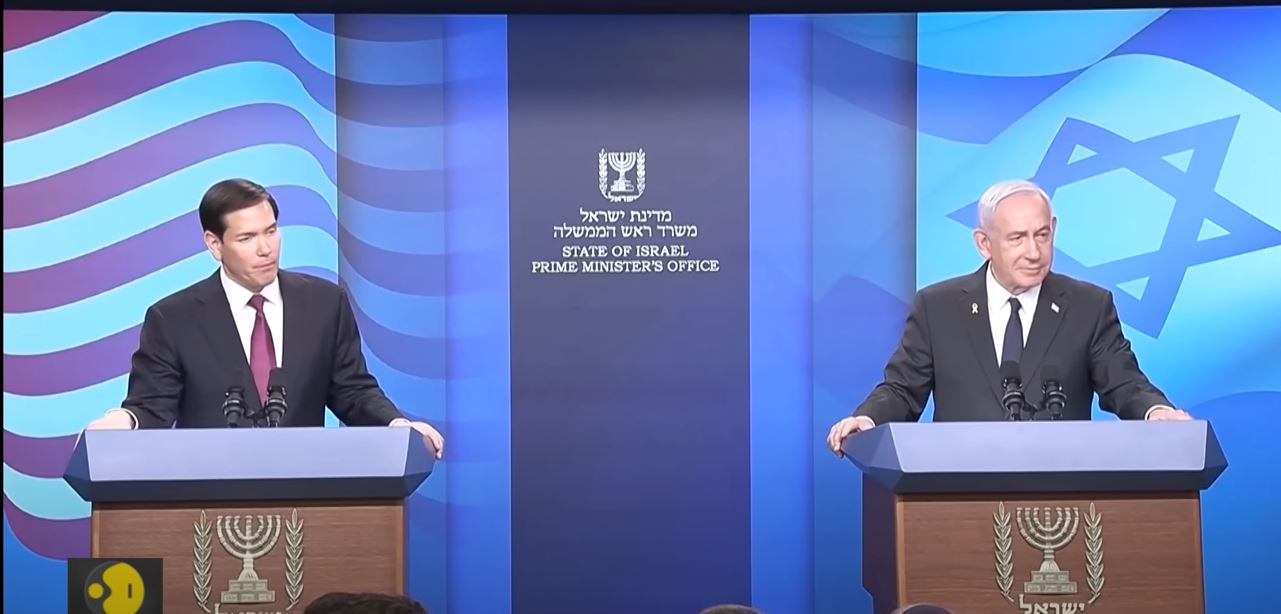
Israeli PM Netanyahu did not rule out more strikes on Hamas leaders abroad, warning that Israel will act wherever it sees threats to its security.
Netanyahu Warns of Possible Strikes on Hamas Leaders Abroad
Netanyahu–Hamas story:
- Netanyahu warns Hamas leaders abroad may face more Israeli strikes amid rising regional tensions.
- Israel’s Netanyahu signals possible overseas strikes on Hamas chiefs, vowing to act against threats.
- Hamas leaders abroad on alert as Netanyahu hints at new Israeli operations beyond Gaza.
Israeli Prime Minister Benjamin Netanyahu has not excluded more strikes against Hamas leaders after last week’s attack in Qatar, telling them they would not have immunity “wherever they are”.
Addressing a news conference in Jerusalem with US Secretary of State Marco Rubio, Netanyahu said that every country had the right “to defend itself beyond its borders”.
Israel’s move to bomb Hamas leaders in Qatar, which is a close US ally, sparked global outcry and condemnation from US President Donald Trump. Six were reported dead by Hamas but its leaders escaped.
Netanyahu’s remarks came shortly after the White House stated that Trump had promised Qatar “that such a thing will not happen again on their soil”.
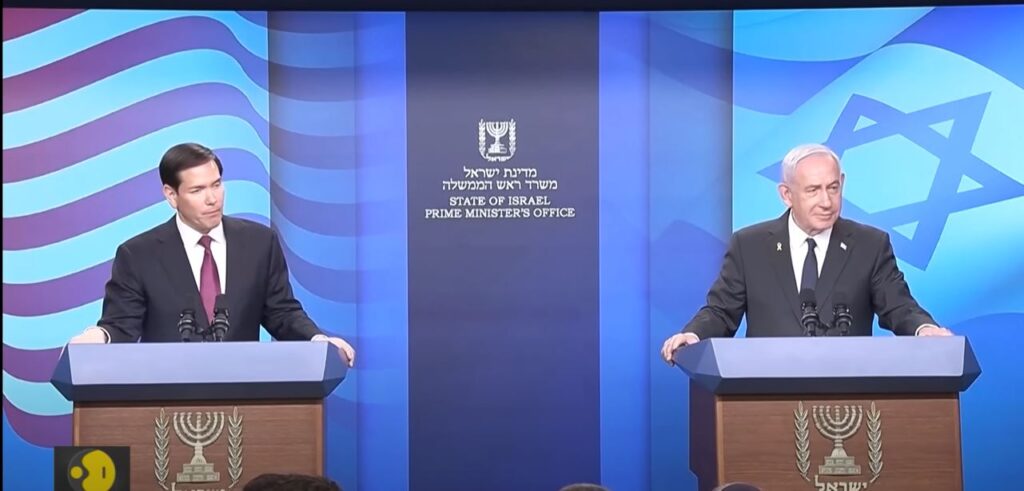
When asked if the US was involved in the strike, Netanyahu said the following to reporters: “We did it on our own. Period.”
To a BBC question of whether the strike had harmed US relations in the region, Rubio said Washington had “strong relationships with our Gulf allies.”.
The couple stood together in a largely united manner, even during the seeming tensions, as Rubio complimented the two nations’ cultural and technological relationships and Netanyahu declared Israel had “no better ally.”
Their meeting occurs as Arab leaders convene a summit in a demonstration of solidarity with Qatar. The Qatari prime minister called on the international community to cease employing “double standards” and to sanction Israel.
Asked subsequently if there were any assurances Israel would not attack the country again, Trump twice replied that Netanyahu “won’t be hitting Qatar”.
Qatar is home to a significant US airbase and has been a leading player in the facilitation of diplomatic attempts to conclude the Gaza war, acting as an intermediary of informal talks between Hamas and Israel. It has been the site of the Hamas political bureau since 2012.
Rubio will then head to Qatar, according to a State Department official, after visiting Israel.
On Sunday, Netanyahu said in a press gaggle that the US-Israel relationship was as “durable as the stones in the Western Wall” as he and Rubio made a brief visit to the site holy to Jews, Christians and Muslims in Jerusalem’s Old City.
During the visit during which they were joined by US ambassador to Israel Mike Huckabee Rubio wrote a note and inserted it into the wall, a ceremonial gesture made by visitors. The men sidestepped questions from reporters centering on Israel’s airstrikes in Qatar.
Likewise reportedly considered by Netanyahu and Rubio are Israeli military ambitions to capture Gaza City and Israel’s ongoing expansion of settlements in the occupied West Bank.
During the weekend, the Israeli military continued with the destruction of residential housing in Gaza City, and according to local sources now stands ready to start ground operations in the Western suburbs of the city.
It has asked Gaza City’s residents to evacuate and travel south to a central part of the strip. The Israel Defense Forces (IDF) believe around 250,000 Palestinians have been forced out, although hundreds of thousands are still in the region.
Some tell us that they do not have the means to travel south, others tell us that it is not safe to travel south because Israel has also conducted air strikes there. Some tell us that they tried to travel south but could not find a place to set up their tents, so they came back to Gaza City.
“They are asking us to evacuate our homes as if they’re asking us to go on a vacation,” said Gaza City resident Hafez Habous.
“Here in Gaza we will die because of one thing: we just don’t have any money. We don’t have tents, we don’t have makeshift shelters, and transport is not available.”
“If you talk to a driver to travel south he wants 300 shekels,” he said – the equivalent of roughly $90 or £65.
“Why? I don’t even have 100. I don’t even have cash for food tomorrow. So how can we travel south?”
The UN warned that a heightening of the attack on a region already declared to be in a state of famine will drive civilians into an “even deeper catastrophe”.
Netanyahu and Rubio’s meeting precedes a UN General Assembly meeting next week, where some prominent US allies including the UK, France, Canada, Australia, and Belgium – are set to recognise the State of Palestine.
This anticipated endorsement has raised arguments in Israel over the future of the West Bank, with increasing hardline forces within the administration maintaining that annexation is the only means by which an Israeli state can be secured against a Palestinian state.
The Israeli government announced final approval in late August for the E1 settlement project east of Jerusalem, which would effectively divide the West Bank into two separate Palestinian populations in the north and south.
Signing the project agreement last Thursday, Netanyahu declared, “We are going to fulfill our promise that there will not be a Palestinian state. This is our place.”
Earlier in the month, Israel’s far-right Finance Minister Bezalel Smotrich presented his plan for the annexation of about four-fifths of the West Bank.
Israel has constructed roughly 160 settlements that contain 700,000 Jews since it took control of the West Bank and East Jerusalem – territory Palestinians hope to have, together with Gaza, in a future state – in the 1967 Middle East war. Around 3.3 million Palestinians reside among them.
The settlements are illegal under international law.
On Monday night, Rubio will tour the City of David archaeological park, opened by a settler group in the Palestinian Silwan neighbourhood, in occupied East Jerusalem.
He will be present at the opening of the “Pilgrimage Road,” a tunnel dug beneath Palestinian houses claimed to indicate the path of a Roman-era street followed by pilgrims to the Biblical temple that once occupied the location known to Jews as the Temple Mount and to Muslims as al-Haram al-Sharif (Noble Sanctuary).
Critics describe the City of David park as an effort to politicize archaeology, at the cost of Palestinian residents.
